For eight months I worked as UX Designer at a small tech firm. It was my first UX job after leaving the world of Human Resources. With a non-existent design team, learning was in my own hands. What follows is a set of reflections from those months as a UX lone wolf.
HOW TO HUNT ALONE: Learning to plan, planning to learn
As a one-person team on the project, I had to learn how to plan, and plan my learning spaces. By the end of the second week the need was obvious. I kept getting lost on where to go next in the workflow. Chaos in workflow creeps in on you if you don’t pay attention. Between researching the project, establishing conceptual grammar, paper sketches and Axure prototyping, I’d landed in a weird feedback loop, constantly re-examining my decisions and bumbling between different ideas. I had to find a way to be clear about my design decisions. Then came the book that practically saved the project for me: The User Experience Team of One by Leah Buley.
If you’re stuck in the “UX designer needed with 5 years of experience” loop while nobody will hire you out of college, you’ll likely have to land an opportunity where you juggle several roles, with no one in the firm who has UX experience. Assuming soft skills are already well-developed, I strongly recommend this book to fellow UX designers in that position. I’d even argue it would be instrumental for an accomplished designer looking to strengthen the culture of UXD thinking in their organisation.
HOW TO HOWL LIKE A WOLF: On soft skills
The book is full of useful advice, but it does assume you can stay empathetic while negotiating tough conversations, making sure your (re)design instructions actually get adopted. That depends on being able to communicate effectively and affectively.
PLAN THE HUNT: Getting a Gantt chart
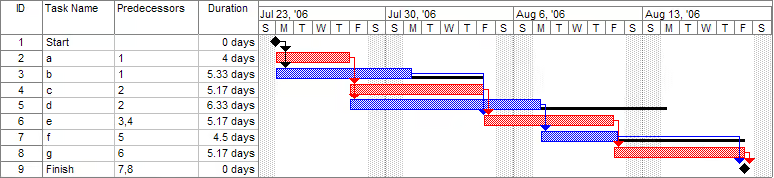
This was for my own sanity more than anything else. When I was back-tracking and second-guessing my decisions, the chart reminded me that once one cycle is done and I have some data on the user, I’ll have to revisit the designs. It’s distinct from the UX-specific project plan the book talks about.
OTHER PACKS: Webinars
I found webinars instrumental for confirming I was on the right track. At the time UXPin and InVision were running design talks and master classes. UXblog was another place I visited to keep my mind fresh with different perspectives.
SPIRIT OF THE WOLF: Passionately dispassionate

It was natural to feel attached to my designs, but the researcher in me knew that user data would break some of the behavioural assumptions I was making. I came to enjoy seeing my assumptions broken. I knew that meant I was getting closer to better designs. I obviously don’t want to be wrong across a whole career, but watching the correct decisions play out smoothly was a great motivator. It’s like filling a circle with small victories: the coherence of your design comes through when enough of the circle is full to achieve 90% of the user’s task.
WOLF FANGS: HTML, CSS, and JavaScript
I had to convert my sketch designs to code, so an addendum had to be added to my learning process. It was genuinely useful, and humbling, to realise what it actually takes to turn a design into code.
STOPPING THE HUNT: Getting breathing room
There are difficult times, complicated, and often confusing due to a lack of direction without an overarching UX strategy. I’d find myself being hard on myself in those moments, and I had to remind myself to take a few minutes for mindful meditation.
WOLF AT THE LAKE: Looking at other packs
I learnt a lot as a lone wolf. But I’ll learn much more on a team where I can bounce ideas, processes, and AHA! moments back and forth. It would save time and sanity.